
Part 2 of a 3-Part Series on Working With Agentic AI. In Part 1, I discussed why Agentic AI should not be viewed simply as a replacement for human labor. As organizations deploy increasingly autonomous AI systems, new responsibilities emerge around supervision, governance, accountability, and continuous improvement.
In Part 2, I want to focus on one of the most important questions leaders must answer before deploying AI agents at scale: What decisions are we comfortable delegating?
Most discussions about Agentic AI focus on what the technology can do. Research. Analyze. Plan. Coordinate. Execute. Those capabilities are impressive. But there is another conversation organizations need to have before deploying AI agents at scale. What decisions are we comfortable delegating?
Every organization delegates decisions today. Managers make decisions on behalf of executives. Employees make decisions on behalf of managers. Policies establish boundaries so people know what they can and cannot decide.
Agentic AI introduces a new challenge. For the first time, organizations can delegate certain decisions to systems that are not human. That sounds efficient. Sometimes it is. Sometimes it creates risks that leaders never anticipated.
As organizations accelerate their adoption of Agentic AI, AI governance is becoming one of the most important leadership disciplines of the decade. AI agents can gather information, analyze data, recommend actions, and execute workflows with increasing autonomy. While these capabilities create opportunities for efficiency and innovation, they also introduce critical questions about accountability, AI risk management, human oversight, and responsible decision-making.
Consider a simple example. A nonprofit deploys an AI agent to identify grant opportunities and prioritize which opportunities staff should pursue. The agent reviews hundreds of funding opportunities and recommends the top ten. Sounds harmless. Until leadership discovers that the agent consistently favors one type of funding opportunity over another because of the data, assumptions, and criteria it was given. The AI did exactly what it was instructed to do. The organization simply never examined the assumptions behind the decision process.
This is where many AI initiatives encounter trouble. The technology performs as expected. The outcomes do not. Agentic AI does not eliminate decision-making. It changes where decisions happen. Some decisions remain entirely human. Some decisions become automated. Many decisions become shared between humans and machines. That creates an important leadership responsibility. Organizations must define:
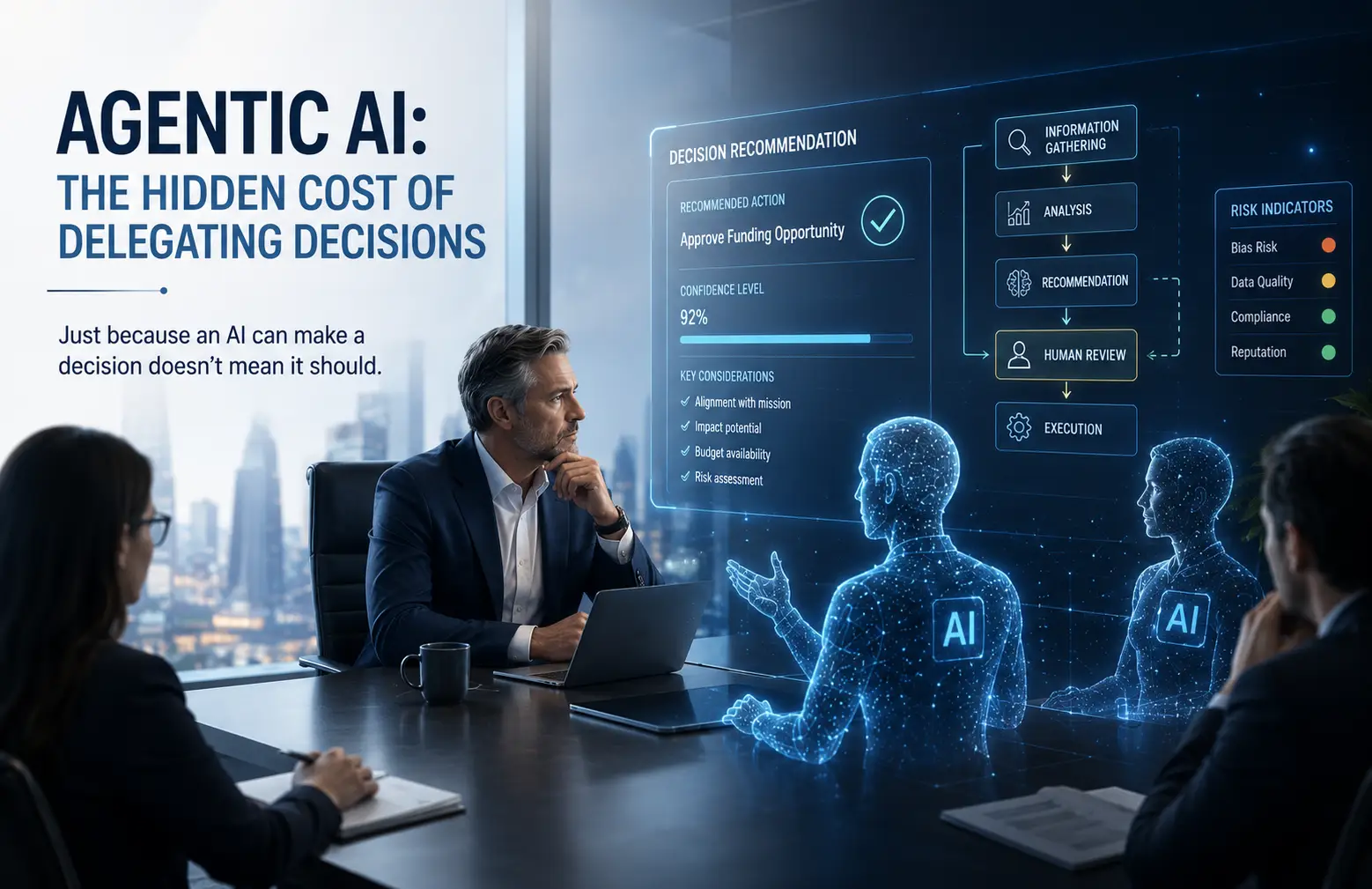
Without those guardrails, organizations often discover they have delegated more authority than they intended. The challenge becomes even greater as agents interact with other agents. One agent gathers information. Another analyzes it. A third recommends actions. A fourth executes tasks. At that point, tracing how a decision was made becomes much more difficult. Organizations may know the outcome. They may not fully understand how the outcome was reached.
This is why AI governance must evolve alongside AI capability. The most successful organizations will not be the ones that automate the most decisions. They will be the ones that automate the right decisions.
One of the most important principles in Responsible AI is maintaining appropriate human oversight. Not every decision should be delegated to an AI agent. Organizations should establish clear guidelines for when humans must review, approve, override, or audit AI-generated recommendations. This approach, often called Human-in-the-Loop AI, helps organizations balance efficiency with accountability while reducing operational, legal, ethical, and reputational risks.
As AI agents become more capable, the importance of human judgment does not decrease. In many cases, it becomes even more important. This is one reason why AI Readiness should be evaluated before organizations deploy autonomous systems. At Fountain Innovation Group, we often refer to this as Phase Zero—the work required to establish governance, accountability, decision boundaries, data readiness, and organizational alignment before AI implementation begins.
Agentic AI is not simply a technology challenge. It is a leadership challenge. Because every time an organization deploys an AI agent, it is making a choice about trust, authority, accountability, and risk. The question leaders should be asking is not: “Can the agent make this decision?” The better question is: “Should it?”
Organizations that answer that question thoughtfully will be better positioned to implement Agentic AI responsibly, establish effective AI governance frameworks, and build the trust required for long-term AI adoption. The future of AI will not be determined solely by what agents can do. It will be determined by how wisely humans choose to govern them.
Category: Blog – LinkedIn Article
Tags: LinkedIn Article
Visit fig-io.com for more insights