
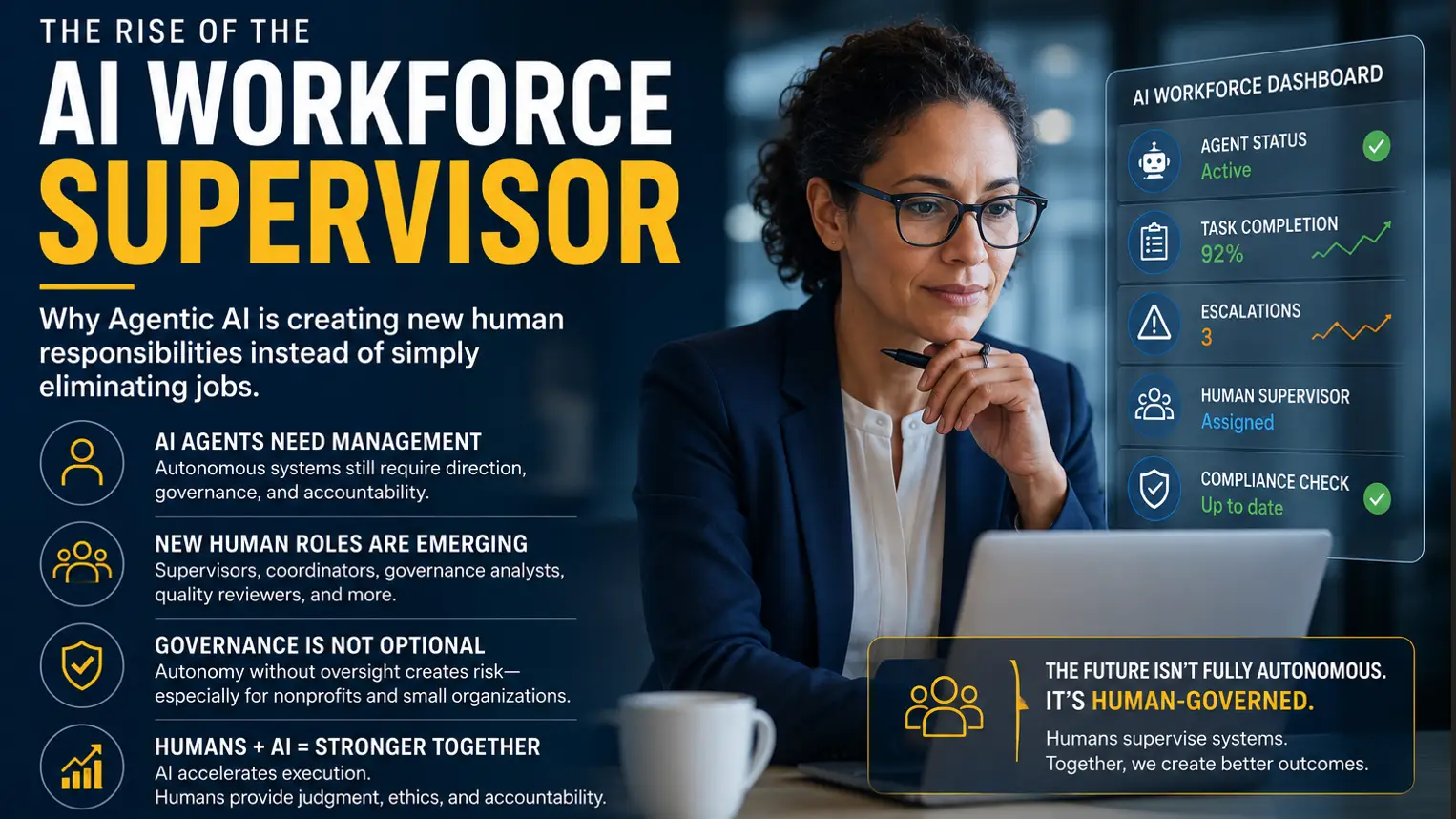
Why agentic AI is creating new human responsibilities — not simply eliminating jobs
The dominant narrative around AI right now is simple: AI replaces workers.
That narrative is incomplete—and for many leaders, it’s misleading.
What organizations are actually moving toward is not full automation. It’s a new operational model where humans supervise increasingly autonomous systems.
That distinction changes everything about how you prepare.
As organizations deploy agentic AI into real workflows, a new category of work is emerging: AI workforce supervision. And most organizations are not ready for it.
Running AI agents is not the same as installing software. It is much closer to managing a workforce — one that executes continuously at scale, without the instincts humans develop over years on the job.
Organizations deploying agentic systems are already discovering the operational reality: these systems drift from intended behavior, make flawed assumptions, mishandle edge cases, and optimize for the wrong outcomes entirely.
Someone must supervise the supervisors.
That responsibility won’t belong exclusively to IT. It will extend across operations, compliance, project management, HR, legal, cybersecurity, and executive leadership.
Because AI decisions eventually become operational decisions. And operational accountability still belongs to humans.
Many executives still frame AI discussions around replacement. But replacement is only part of the story. The larger shift is role transformation.
Over the next several years, organizations will create positions that don’t exist today:
These roles will emerge inside PMOs, operations teams, nonprofits, healthcare organizations, schools, and local governments.
AI may accelerate execution. But humans still determine whether that execution should happen in the first place. Context, ethics, organizational nuance, and accountability cannot be automated.
Augmentation-first is not a compromise. It is the more defensible strategy.
Large enterprises have dedicated governance offices, legal teams, cybersecurity departments, and operational risk programs. Most nonprofits and small organizations do not.
That asymmetry matters. Poorly supervised AI adoption creates disproportionate exposure for smaller teams.
A community organization cannot easily absorb donor trust failures, inaccurate communications, reputational damage, or flawed automated decisions. The cost of a single governance failure can outweigh years of efficiency gains.
For most small organizations, the right strategy is human-supervised augmentation — not unsupervised replacement.
That’s not a lesser version of AI adoption. It’s the version that is actually sustainable.
This shift changes the role of operational leadership fundamentally.
Traditional PMOs managed timelines, budgets, dependencies, and delivery governance. Future-ready operational leaders will also own:
In many organizations, operational leaders will become the coordination layer between business operations, compliance, governance, and autonomous systems.
The PMOs and operational teams that recognize this early will become significantly more valuable — not less.
Right now, many organizations are rushing employees through prompt engineering workshops, AI tool demonstrations, and productivity training.
Those investments are useful. But they are not operational readiness.
Operational readiness means building disciplines around escalation handling, auditability, human override authority, workflow monitoring, exception management, and continuous system improvement.
The gap between AI literacy and AI governance is where most organizations will fail.
Closing that gap is not a technology problem. It is a leadership problem.
The future of AI adoption is not:
“People replaced by systems.”
It is:
“Humans supervising systems that supervise processes.”
That creates an entirely new category of leadership responsibility — one most organizations are still underestimating.
Organizations that prepare their people for oversight roles will adapt far more successfully than organizations focused only on short-term labor reduction.
Autonomy without governance does not scale safely.
Every organization deploying agentic AI will eventually discover this. The question is whether they discover it before or after something goes wrong.
Ready to build your AI governance foundation?
Download The Ascent to AI — a free guide to operational AI readiness for leaders who need more than a tool demo: www.getstairready.com/ebook
The organizations I’m watching most closely aren’t the ones moving fastest toward automation. They’re the ones building oversight infrastructure before they need it.
The question I’d ask your leadership team: if your AI agents started producing flawed outputs at scale tomorrow, who owns that problem? Who has the authority to stop it? Who reviews whether it’s fixed?
If those answers aren’t clear, that’s your readiness gap. Drop a comment — I’ll share what that governance structure typically looks like.
Category: Blog – LinkedIn Article
Tags: LinkedIn Article
Visit fig-io.com for more insights