
By George Fountain Jr., MBA, PMP, CPMAI+E
For more than two thousand years, medicine has recognized an enduring ethical principle: First, do no harm.
Those exact words do not appear in the original Hippocratic Oath, but the principle has become closely associated with medical ethics and the responsibilities of those entrusted with human lives.
Physicians have extraordinary knowledge, sophisticated equipment, and increasingly powerful technology. Yet the responsibility to protect patients remains fundamentally human.
Artificial intelligence needs the same commitment.
As AI systems become more capable and autonomous, we need a clear principle:
AI must serve humanity, minimize foreseeable harm, and remain subject to meaningful human accountability.
Making that commitment is the easy part. Putting it into practice is the real work.
A Human in the Loop Is No Longer Enough
For years, one of the standard approaches to responsible AI has been keeping a Human in the Loop (HITL).
The concept is straightforward. AI performs a task, and a person reviews, approves, or intervenes when necessary.
That approach works when AI handles a manageable number of tasks. But it becomes increasingly difficult when organizations deploy hundreds, or potentially thousands, of autonomous AI agents.
Consider a frontier organization where AI agents manage customer interactions, analyze financial transactions, monitor cybersecurity, support project delivery, process information, and coordinate work with other agents.
These systems may operate continuously, execute thousands of transactions, and make decisions at speeds that exceed human review capacity.
No individual, and no small team, can realistically review every action or approve every decision. Attempting to do so would eliminate much of the operational value these systems were designed to provide.
Meaningful human oversight must be redesigned for scale.
This is where I believe we need to expand our thinking.
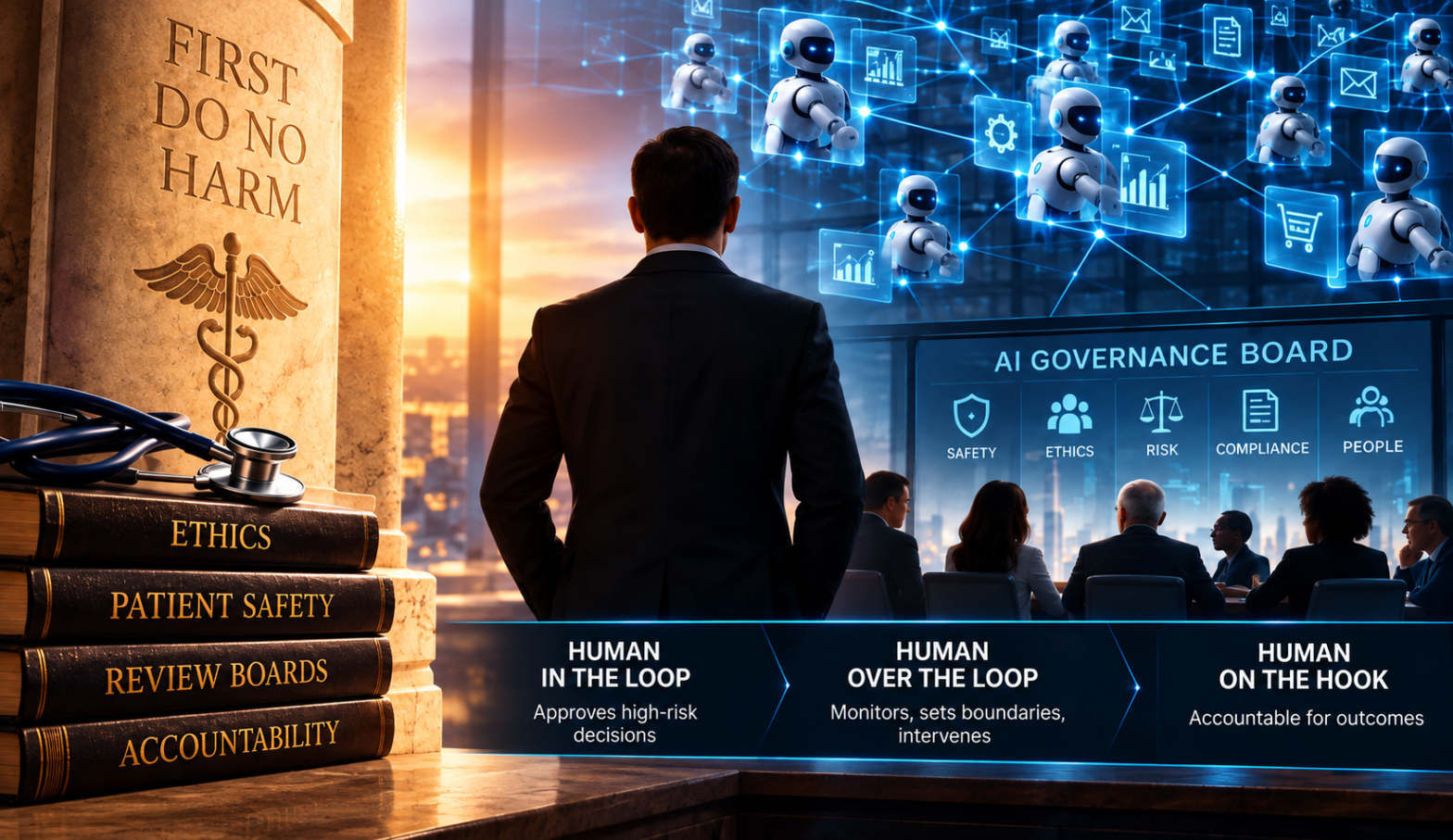
At scale, Human in the Loop must evolve into Human Over the Loop. But someone must still be Human on the Hook.
These represent three complementary responsibilities:
Human in the Loop: Reviews and approves specific high-risk decisions before execution. This remains essential when an AI action could produce serious or irreversible consequences.
Human Over the Loop: Supervises AI operations, establishes boundaries, monitors exceptions, and intervenes when necessary. This is closely related to the established concept of Human on the Loop, where humans supervise automated systems rather than approve every individual action.
Human on the Hook: Has clearly defined accountability for the system’s responsible operation and for the organization’s response when something goes wrong.
These responsibilities can be distributed among different people and teams, depending on the organization’s size, risk exposure, and operating model.
The objective is not to have a human approve everything.
The objective is to ensure AI operates within established boundaries and that human accountability never disappears.
Medicine Already Offers a Governance Model
Medicine has considerable experience managing decisions with potentially life-changing consequences.
Consider organ transplantation, clinical research, or the introduction of new medications into patient care.
These activities often involve more than the judgment of a single physician.
Transplant selection committees evaluate complex medical and ethical considerations. Institutional review boards assess research involving human participants. Pharmacy and therapeutics committees evaluate medication use and related policies within healthcare organizations.
Each operates under different responsibilities and standards, but they demonstrate a common principle.
The greater the potential consequences, the greater the need for structured, multidisciplinary oversight.
AI needs a comparable approach.
Organizations deploying consequential AI systems should establish an AI Governance Board or an equivalent oversight structure.
Depending on the organization, this group should include representatives from technology, operations, legal, risk management, cybersecurity, and the business functions affected by AI.
Where appropriate, it should also consider the perspectives of customers, employees, and other people whose lives may be affected by AI decisions.
The purpose of this board is not to approve every action performed by an AI agent.
Its responsibilities should include establishing acceptable risk boundaries, authorizing high-impact deployments, reviewing serious incidents, evaluating system performance, and determining when systems must be modified, suspended, or retired.
Importantly, the board must have the authority to act.
If an AI system presents an unacceptable risk, governance leaders must be able to suspend its operation, even when doing so disrupts business activities.
Patient safety sometimes requires healthcare professionals to delay or stop a procedure. Responsible AI governance must be prepared to make similarly difficult decisions.
For smaller organizations, these responsibilities may be assigned to an existing leadership group rather than a formal board.
The structure can vary. The accountability cannot.
Every Consequential AI System Needs a Human on the Hook
Imagine an autonomous AI agent authorized to access organizational records, communicate with customers, or initiate financial transactions.
Now suppose that agent exposes sensitive information, makes an unauthorized commitment, or takes an action that causes significant harm.
The organization cannot simply explain that the AI made the decision.
Someone authorized its deployment. Someone established its operating boundaries. Someone accepted the risks associated with its use.
And someone must be accountable for how the organization responds when those boundaries are crossed.
This does not mean one individual should automatically be blamed for every AI failure.
Accountability must reflect actual authority, organizational responsibilities, and the decisions that contributed to the outcome.
Developers remain responsible for their assigned engineering obligations. Executives remain accountable for organizational decisions. Project managers have responsibilities for planning, delivery, risk management, and escalation within their authority.
The designated system owner must have sufficient authority to oversee the AI system, address unacceptable performance, and escalate concerns.
The Human on the Hook is not necessarily the person who writes the code or operates the system.
It is the person with clearly assigned accountability for ensuring that the system operates responsibly within the organization’s governance structure.
And where accountability is shared, those responsibilities must be explicitly defined.
Delegating work to AI does not delegate away human accountability.
That principle holds whether an organization operates one AI assistant or ten thousand autonomous agents.
What Would an AI Hippocratic Oath Look Like?
If we expect AI to influence decisions affecting people’s health, finances, employment, education, security, and opportunities, organizations should commit to a common set of ethical obligations.
I propose five foundational commitments.
1. Minimize Foreseeable Harm
Organizations must identify and reduce reasonably foreseeable risks before deploying AI and continue monitoring for emerging risks afterward.
No technology can guarantee the absence of harm. But preventable harm should never be dismissed as an unavoidable consequence of innovation.
2. Preserve Meaningful Human Authority
Humans must retain the ability to review, challenge, override, or stop consequential AI actions.
The degree of human involvement should reflect the potential impact of the decision.
Routine activities may operate autonomously within approved boundaries. High-risk decisions may require direct human approval.
3. Establish Accountability Before Deployment
Every consequential AI system must have clearly defined ownership, oversight responsibilities, escalation procedures, and decision authority.
Organizations should never wait for a serious incident to determine who is responsible.
4. Be Transparent About Limitations
Users and decision-makers must understand what an AI system is authorized to do, where it may fail, and when human judgment is required.
AI-generated confidence must never be confused with verified accuracy.
5. Protect Human Dignity and Agency
AI should strengthen people’s ability to make informed decisions, perform meaningful work, and participate in society.
Its deployment must respect privacy, safety, fairness, and fundamental human rights.
These commitments should be reflected in organizational policies, operating procedures, system design, and deployment decisions.
An oath without accountability is only a promise.
Accountability Must Have Consequences
Medicine’s ethical commitments are supported by professional standards, licensing requirements, institutional oversight, and legal accountability.
AI governance is still developing, and its legal and regulatory requirements differ across industries and jurisdictions.
Organizations cannot assume that a universal system of professional accountability already exists for everyone who develops or deploys AI.
That makes internal governance especially important.
An organization should be able to demonstrate who approved an AI system, what risks were identified, what safeguards were established, and what actions were taken when problems emerged.
Accountability also requires documentation, monitoring, incident reporting, and periodic independent review.
A governance board that cannot obtain accurate information about system performance cannot provide meaningful oversight.
A system owner who cannot intervene when necessary cannot exercise meaningful authority.
And an organization that repeatedly ignores warnings cannot credibly claim that it has responsible AI governance.
Human accountability must be operational, measurable, and enforceable.
Responsible AI Begins Before Implementation
Too many organizations begin their AI journey by selecting a tool, launching a pilot, or asking what they can automate.
Those activities may demonstrate technical possibilities. They do not establish whether the organization is prepared to operate AI responsibly.
That preparation requires decisions before implementation begins.
Leaders must understand the business problem, the people affected, the available data, the technology environment, and the governance required to support deployment.
For autonomous AI agents, this means establishing what each agent is authorized to do, which actions require human approval, how exceptions will be monitored, and who has the authority to intervene.
It also means determining which deployments require formal governance review and identifying the Human on the Hook.
For organizations operating multiple agents, these decisions become even more important.
Agents may interact with other agents, share information, initiate workflows, and produce outcomes that no single person directly authorized.
Organizations need visibility into these interactions, clear limits on agent authority, and procedures for identifying and containing unintended behavior.
These are not simply technical design decisions. They are organizational risk and governance decisions.
This is an important responsibility for project managers.
Project managers have long been expected to identify risks, establish controls, define responsibilities, manage change, and escalate issues before they become serious problems.
Those disciplines are directly applicable to AI initiatives.
The project manager does not replace the AI system owner or governance board. Instead, project management provides a structured way to ensure that accountability, risk management, and oversight requirements are addressed throughout the implementation lifecycle.
This preparation is especially important for small businesses, nonprofits, and public-sector organizations that may lack dedicated AI governance teams.
Responsible AI should not be a privilege reserved for organizations with large budgets and extensive technical resources.
Every organization deploying consequential AI needs a practical way to determine whether it is ready.
The Human Must Remain Accountable
We cannot predict every way artificial intelligence will evolve.
But we can already see that autonomous AI agents are challenging traditional approaches to management, supervision, and accountability.
A human cannot approve every action taken by thousands of agents.
Humans can, however, establish the rules under which those agents operate, monitor their performance, define when intervention is required, and ensure that someone remains accountable.
Medicine developed ethical standards and governance structures because human lives and well-being depend on responsible professional judgment.
AI increasingly influences decisions that affect those same lives.
It deserves a comparable commitment to safety, oversight, and accountability.
That responsibility belongs to developers, executives, project managers, governance professionals, and every organization that authorizes an AI system to operate.
The question is no longer simply whether AI can perform the work.
It is whether we have established the human authority and accountability necessary to trust it with that work.
Because when AI makes a consequential mistake, no one should be left wondering who was responsible.
About the Author
George Fountain Jr., MBA, PMP, CPMAI+E, is an AI strategy and project management professional and founder of Fountain Innovations Group, L.L.C. His work focuses on helping organizations prepare for responsible AI adoption through readiness assessments, governance, and structured implementation planning. Through StAIR-Ready™ and AIPhaseZero™, he helps organizations address the decisions that should be made before AI goes live.
Learn more at [Fountain Innovations Group](https://fountaininnovationsgroup.com).